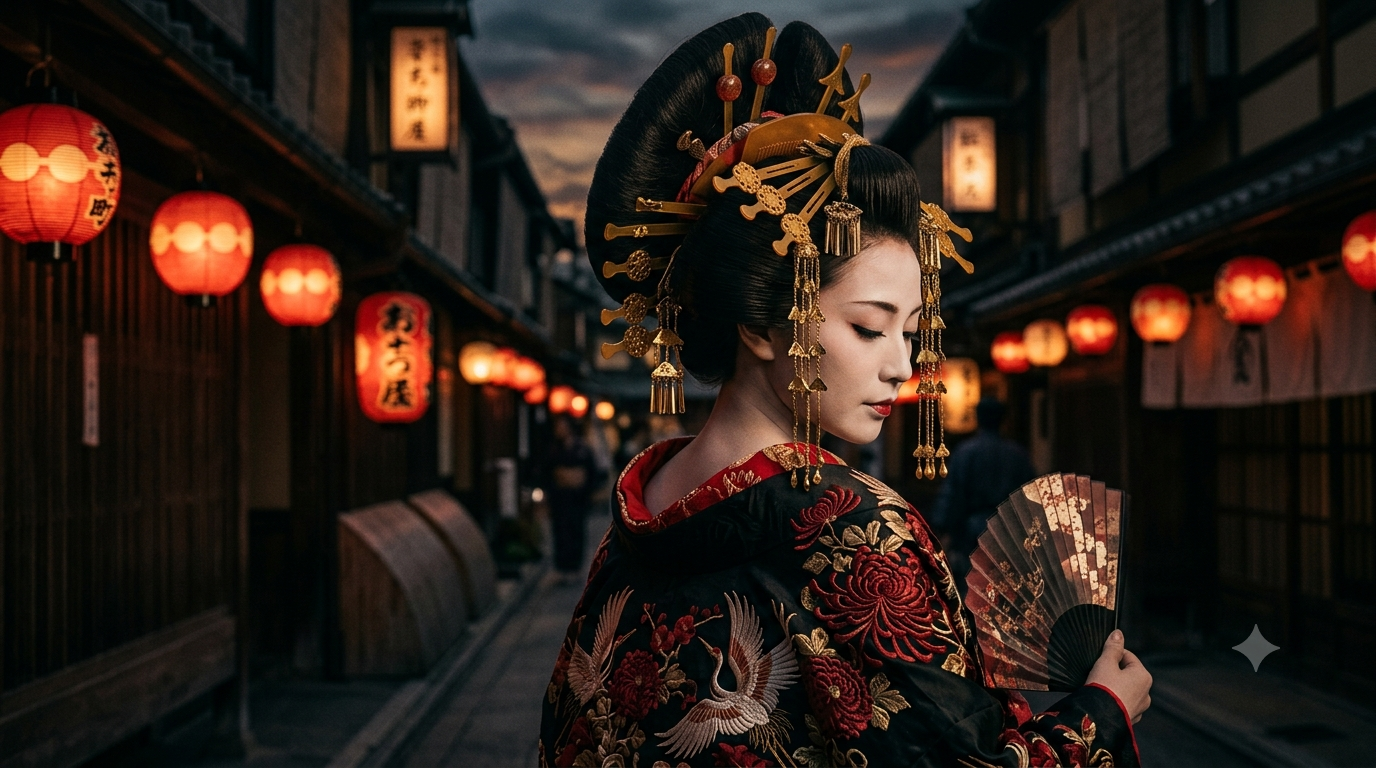
Yo, it’s Sankyu. You watched the Yoshiwara arc in Demon Slayer and thought, “oh, so this is what a geisha looks like — kimono, shamisen, a little spicy energy.”
Wrong. Dead wrong. That’s not a geisha. That’s an oiran.
Honestly, this mix-up is on the level of The Matrix — you grabbed the red pill and the blue pill and swallowed both at once. Something definitely changed, but you’re now running in the completely wrong direction.
And here’s the kicker: while actual Japanese people sat back and did nothing, Wikipedia and half the Western internet quietly agreed “eh, close enough” and let the confusion spread. It’s a full-blown game of cultural telephone — starts as “geisha = performing artist,” ends up as “geisha = high-class sex worker.”
It’s basically Yamcha getting mistaken for Vegeta-tier. Okay, maybe that’s a stretch. But the point stands: two completely different jobs, two completely different ranks, shoved into the same box.
Today, an actual Japanese guy is going to rip this misunderstanding apart at the root. Keep up. Don’t you dare look away.
The Verdict — 99% of You Have Been Getting This Wrong
Bottom line:
- Geisha = a performer. A professional in shamisen, dance, and the art of conversation at a teahouse. Sexual services are not part of the job. Think of her as a top-tier entertainer and hostess rolled into one.
- Oiran = a courtesan. Someone who sold sex, period — the highest rank of courtesan working inside Yoshiwara, Japan’s government-licensed red-light district.
- The timeline mix-up: when Yoshiwara opened in 1617, the top-ranked courtesans were actually called tayu. The word “oiran” didn’t even exist yet — it emerged in the mid-1700s, after the tayu rank declined, as a new title for the top courtesans who replaced them. So oiran weren’t Yoshiwara’s founding stars — they were the “second generation” that took over once the originals faded out.
- The visual mix-up: elaborate kimono, white makeup, ornate hair ornaments — the overlap is so heavy that even modern Japanese people sometimes can’t tell the two apart at a glance.
- Today: geisha are still active, with legitimate geisha houses operating in Kyoto and Tokyo. Oiran, as a profession, officially ceased to exist when Japan’s Anti-Prostitution Law took effect in 1958.
- What you see labeled “oiran” now: tourist reenactment shows and photo-studio makeover experiences — a modern “experience product,” not the actual historical job.
Why does the confusion run this deep? Simple — Western media flattened both into one vague image: “mysterious, alluring woman in a kimono.” The film Memoirs of a Geisha deserves a good chunk of the blame here too — the source material itself blurs the line between geisha and oiran.
Why Did the Government Bother Building a “Sex Quarantine Zone”?
After Tokugawa Ieyasu took Edo in 1590, waves of male laborers poured in for construction work, skewing the city’s population heavily male. Unlicensed brothels popped up everywhere, and complaints about the resulting disorder reached the shogunate. Brothel owners petitioned to consolidate everything into one officially sanctioned district — and in 1617, permission was granted. This is how Yoshiwara began.
The shogunate had its own incentive too: licensing the district meant collecting taxes (a kind of tribute payment), while also making it far easier to monitor who came and went.
The short version: a male-heavy construction boom collided with the shogunate’s need for tax revenue and public order, and out came a government-private-sector joint venture in the sex trade. That’s the real origin story of Yoshiwara.
Turns Out Oiran Were the “Second Generation” — Did You Know That?
When Yoshiwara opened in 1617, courtesans were ranked in three tiers: tayu, koshi, and hashijoro, with tayu at the top. A tayu wasn’t just beautiful — she was expected to master waka poetry, calligraphy, and tea ceremony. Money alone didn’t get you an audience with one; you had to be chosen through wit and refinement too. Think of it as the single highest tier of an extremely competitive matchmaking market.
But by the mid-1700s, thanks in part to the shogunate’s austerity policies, the tayu rank started thinning out. In its place, “oiran” became the new title for the upper-tier courtesans who took over.
In other words: oiran weren’t there from day one. They inherited the top spot after tayu faded away.
Did You Know Mixing Up Geisha and Oiran Used to Be Punishable?
By the 18th century, a new kind of demand emerged: customers who didn’t want to sleep with a courtesan, but still wanted the glamour, the conversation, the performance. That’s how geisha — professionals whose work excluded sexual services entirely — became an independent profession.
Marvel-style comparison: if oiran were the Avengers (the full package), geisha were Hawkeye getting his own spin-off.
The shogunate established a registration and oversight system called kenban, which explicitly banned geisha from providing sexual services. In other words, the government itself drew a hard legal line — “do not confuse these two” — only for Western media, three centuries later, to blow right through it.
What Happened to Yoshiwara? How Oiran Split Into Modern Japan’s Sex Industry
The oiran profession officially ended on April 1, 1958, when Japan’s Anti-Prostitution Law took effect — shutting down 340 years of Yoshiwara history in one legal stroke. Geisha, meanwhile, survived untouched, since their work never included sexual services. Legitimate geisha houses still operate today in Kyoto’s Gion district and Tokyo’s Asakusa. Oiran got swept away by the tide of history; geisha didn’t.
Think Attack on Titan — the ones left outside the wall versus the ones who made it inside. That’s the gap.
But the function oiran once served didn’t vanish completely. Japan’s modern sex industry absorbed and fragmented that function across a handful of legally distinct business categories that still operate today.
Soaplands, “Health” Parlors, Delivery Health — What If They’re All Descendants of the Oiran?
Soaplands. A storefront business offering services in a private bathing suite, tracing its roots to Japan’s old “Turkish bath” culture. Legally classified as a “special bathhouse” — the only sex-industry category regulated by public health authorities rather than the police, complete with surprise inspections. Prices start around ¥20,000 for a standard 40–60 minute session at budget establishments, climbing to ¥50,000–¥100,000+ at high-end venues.
“Health” parlors. Storefront venues with private play rooms offering some sexual services, but full intercourse is officially off-limits — and that single line is exactly what lets them avoid the heavier regulation soaplands face. Prices start around ¥10,000 for 60 minutes.
Pink salons. Legally registered as restaurants rather than sex businesses — the cover story being that a drink is always served. In practice, sexual services happen anyway, and one district court ruling folded this into the legal definition of “hospitality” under the entertainment business law.
Sensual massage parlors. Start under the cover of “massage” and drift into softer sexual services as the session goes on. Prices run about ¥15,000–¥30,000 for 60 minutes.
Delivery health (deriheru). Legally a “storefront-free licensed sex business” — companies dispatch women to a customer’s home or hotel. Legalized in 1998, it’s now the industry’s dominant format. Rough pricing: around ¥15,000 for 60 minutes, ¥20,000 for 90, ¥30,000 for 120, plus transportation fees.
Titty pubs. No ejaculation-related service — basically “a hostess club with touching allowed.”
Why Does This Industry Refuse to Die Every Time the Law Cracks Down?
Starting with the postwar Adult Entertainment Business Law, a 1985 revision effectively froze new storefront licenses for health parlors. Then in 1998, delivery health was legalized, and storefront-free businesses became the industry standard.
How Much Money Do You Think the Oiran Economy Is Worth Today?
Industry estimates (private research, not official government statistics) put Japan’s entire sex industry at roughly ¥5–7 trillion a year. Broken down by category: delivery health alone is estimated at around ¥2.5 trillion, soaplands at ¥980 billion, and health parlors at ¥670 billion.
On the cultural side, the modern echo of “oiran” survives in three forms: reenactments of the oiran procession, photo-studio makeover experiences, and symbolic characters in fiction — Demon Slayer‘s Yoshiwara arc, obviously, but also Komurasaki from One Piece‘s Wano arc, a hardcore-accurate oiran character whose title even echoes the tayu lineage.
The West Had Its Own “Oiran” Too — Just Without the Cage
When Western readers search “geisha,” what usually comes to mind is a vague, dreamy image: “the mysterious woman of the East.” A lot of that comes down to Memoirs of a Geisha.
So did the West have anything equivalent to the oiran? Actually, yes. France’s courtesans — figures like Ninon de l’Enclos — line up strikingly well with the tayu rank structure. France had its own pinnacle: the grande courtisane.
Here’s where they differ: Japan’s oiran system was a state-licensed, walled-in enclosure. Western courtesans, by contrast, operated with far more personal freedom and independence.
Game of Thrones comparison: oiran were the crown-sanctioned Littlefinger, confined to working King’s Landing and nowhere else. Courtesans were the freelance Littlefinger, welcome in any court in the land.
Want to Know What I Can’t Say Here?
So, gentlemen across the ocean — feeling tempted to go find yourself a “modern-day oiran” while you’re in Japan?
Not so fast. You haven’t even reached the real story yet. The oiran rank system makes high school social hierarchies look tame by comparison. And here’s the thing: to keep Google happy, this article hasn’t named a single specific modern Japanese adult service in detail.
But I know exactly what they are. Want to know? Sign up for the newsletter if you do. Don’t you dare tell your mom.
References
Historical details on Yoshiwara’s courtesan ranking system draw on general early-modern Japanese historical sources and commentary from researchers at the National Museum of Japanese History. Legal classifications of modern sex-industry categories draw on publicly available information from Japanese police and Adult Entertainment Business Law reference sites. Market-size figures come from multiple private industry research sources — not official government statistics. Full citations to follow.
That’s It for Today
Thanks for sticking around till the end. There’s still plenty more darkness where the oiran story came from. Whether you’re curious about Komurasaki from One Piece, or just want to know what happens next — sign up for the newsletter, then go check out the other articles.
And seriously. Read this one alone.